
The experience of discovering one’s roots, as anyone who has done so can attest, is deeply grounding and often offers a change in perspective. Mai, who is known as Mia to her friends, has a name that captures the duality of life as a native of the California sand and sunshine with Vietnamese roots. The events in this book, however, occur in the latter location, where she accompanies her grandmother (Ba, in Vietnamese) to follow the trail of her Ong, or grandfather, who disappeared and was never heard from again during the Vietnamese War. It is the summer before 7th grade, and she is nervous about what is happening at her home, for some reasons that are often attributed to this age (read: crushes). Moreover, she dreads the prospect of spending most of her summer with her grandmother and people from Ong’s former village, to whom she may or may not be related. Alone, since her mother has decided, of course, to stay in California to prosecute an all-important case; her father, meanwhile, has left to practice surgery on children living in rural villages in the distant mountains of Vietnam. A detective has found possible evidence of where Ong went in the form of a former guard of his, when Ong was captured and sent to the North of Vietnam. The detective and his loquacity factor heavily in this story. However, the process of getting the guard to where Ba is, and persuading him to tell all of what he knows, takes forever. During which, Mai is forced to stay in a new and unfamiliar village acclimating to her surroundings. Understandably, this is something she’s none too happy to do. A moving premise. A fresh narrator. A summer that will be like no other. The themes that resonated with me were finding one’s roots, especially those that are far away, perhaps in another country. Learning about Vietnamese culture? A welcome addition. Seriously, learning about your culture, and your grandfather whom you never knew, only heard about is almost as fresh and engaging of a plot as is possible. Mai’s distinctive voice (teenager in a new, unfamiliar country) mostly helps the story along, but there are instances where it muddles up the story and the experience. All the reduced relative clauses and casual narration may force a few rereadings of those offending lines. What is supposed to be an easy read turns into a moderately-difficult one. The same can sometimes be said about the plot and pacing. While most of the time it emphasizes Mai’s new experiences and her becoming ever closer to her heritage and the people who are a part of, and near it, some of these just demonstrate her snarky attitude, acting as filler for the plot. Without trodding into spoiler territory, I can say that some of the things she brings over, while slightly funny, do nothing to move the plot forward (perhaps because the author felt the book would be too short to be meaningful?) This isn’t true, as Ba’s poetic stories—about meeting Ong, naming her children, learning about his disappearance—usually stretch for a page or more, but offer a deep and resonant connection to this person, searching for her husband after all these years—if anything, just to let go and move on. They end the chapters they are introduced in with a sense of finality, as both we and Mai ruminate over these words. Another possible gripe is that aside from Mai and Ut and Ba, many of the massive cast of characters are not fully developed. So if you enjoy picking up books with many diverse characters, you are out of luck. Let me introduce you to some of them. Her dad and mom could very well be totally absorbed by their work. We hear, very rightly, from Mai’s thoughts, that her father should be accompanying his mother on this trip, instead of leaving Mai to “take care” of her grandmother. We already see the connection between grandmother and granddaughter, so wouldn’t it be good to also see the bond between mother and son, even through a few sentences near the end? Instead, we only get a brief comment about how Mai’s father, Mua, meaning rain in Vietnamese, likely thinks his name is strange. I mean, come on. This book is definitely recommended for anyone who wants to learn about Vietnamese culture or Vietnamese history (particularly the Vietnam War), or has Vietnamese roots, or really anyone who has ever learned, or are planning to learn about one’s roots and the lives of one’s ancestors. Though not everyone will like the narration style or slightly-jumbled events, most all will like the heartfelt, original story of this poignant middle-grade novel.
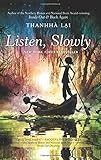
Listen, Slowly
By Thanhha Lai
| Interest Level | Reading Level | Reading A-Z | ATOS | Word Count |
|---|---|---|---|---|
| Grades 4 - 8 | Grades 3 - 6 | n/a | 5.3 | 62059 |
Listen, Slowly is a New York Times Book Review Notable Book and a Publishers Weekly Best Book of the Year! This remarkable and bestselling novel from Thanhha Lai, author of the National Book Award–winning and Newbery Honor Book Inside Out & Back Again, follows a young girl as she learns the true meaning of family.
A California girl born and raised, Mai can’t wait to spend her vacation at the beach. Instead, she has to travel to Vietnam with her grandmother, who is going back to find out what really happened to her husband during the Vietnam War. Mai’s parents think this trip will be a great opportunity for their out-of-touch daughter to learn more about her culture. But to Mai, those are their roots, not her own. Vietnam is hot, smelly, and the last place she wants to be. Besides barely speaking the language, she doesn’t know the geography, the local customs, or even her distant relatives. To survive her trip, Mai must find a balance between her two completely different worlds.
Perfect for fans of Rita Williams-Garcia and Linda Sue Park, Listen, Slowly is an irresistibly charming and emotionally poignant tale about a girl who discovers that home and culture, family and friends, can all mean different things.
